US Person is taking a well-deserved break. Come back next week for more high-impact blog at PNG.
Wednesday, April 08, 2015
Tuesday, April 07, 2015
COTW: The Buffet Indicator
The "Oracle of Omaha", better known as Warren Buffett, has made himself and a lot of his investors filthy rich picking stocks. In fact he has a stock market indicator named after him and that is the subject of this week's chart:
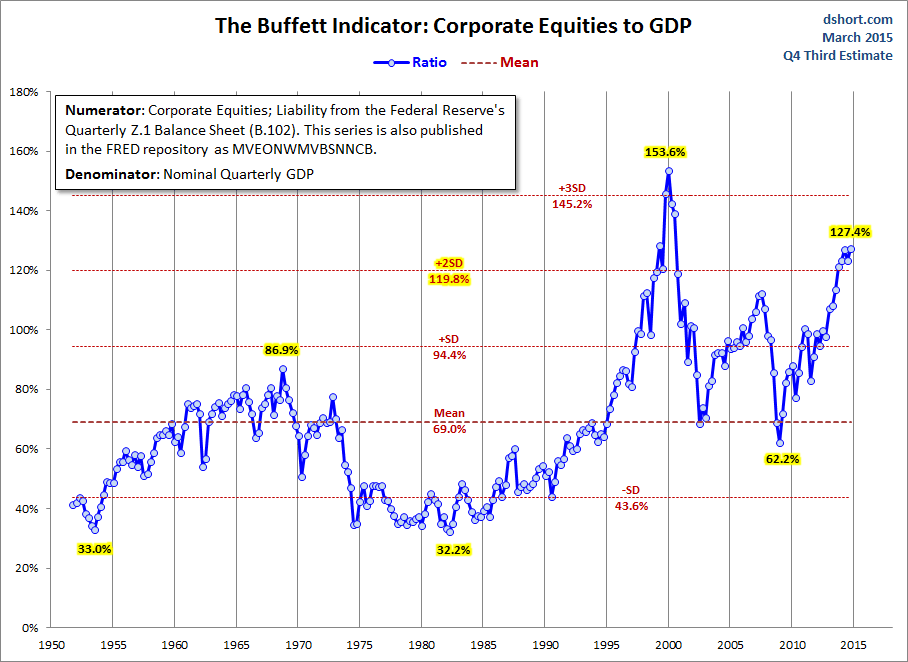
The ratio of total market capitalization to gross national product is charted above. Currently it is 127% Buffett told us in Fortune to buy stocks when the ratio is in the 70 to 80% region, meaning that relative to the economy valued by GNP stocks are inexpensive. When stocks are expensive relative to economic activity, over 100, and the ratio approaches 200%, he said "you are playing with fire." Whatever you think of Buffett who is the epitome of a modern financial capitalist (his company Berkshire Hathaway does not make anything because it is a stock holding company) he practices what he preaches. He buys low and sells high [misnamed chart below]. Because he is an insider with more information than you dear reader, his stock plays are often profitable Right now Berkshire is sitting on its largest accumulation of cash and cash equivalents ever.

The ratio of total market capitalization to gross national product is charted above. Currently it is 127% Buffett told us in Fortune to buy stocks when the ratio is in the 70 to 80% region, meaning that relative to the economy valued by GNP stocks are inexpensive. When stocks are expensive relative to economic activity, over 100, and the ratio approaches 200%, he said "you are playing with fire." Whatever you think of Buffett who is the epitome of a modern financial capitalist (his company Berkshire Hathaway does not make anything because it is a stock holding company) he practices what he preaches. He buys low and sells high [misnamed chart below]. Because he is an insider with more information than you dear reader, his stock plays are often profitable Right now Berkshire is sitting on its largest accumulation of cash and cash equivalents ever.
Monday, April 06, 2015
Pass the Olive Oil, Please
Mediterraneans are noted for a lower incidence of heart disease and cancer than Northern Europeans and thier progeny in the United States. this advantage has been long been attributed to their diet which is high in olive oil among other factors. A recent laboratory investigation reported in the journal "Molecular and Cellular Oncology" shows that a compound in olive oil, oleocanthal, ruptures certain cancer cell structures that releases enzymes causing cell death. While oleocanthal was known to kill cancer cells previously, the mechanism was not understood by science. Oleocanthal ruptures lysosomes that store waste products. Lysosomes are larger in cancer cells than in normal ones. When a lysosome ruptures, enzymes are released that cause the cancer cell to die within thirty minutes to an hour. Oleocanthal does not harm normal cells. It stops a normal cell's life cycle temporarily, but a day after exposure normal cells resume their cycle. Why oleocanthal has this desirable selective lethality is not yet known. Hundreds of milions of dollars have been invested by drug companies synthesizing cancer drugs to obtain this characteristic.
Researchers hope to go beyond the petri dish to find if oleocanthal can kill cancer cells in living animals. Olive oil contains more than thirty compounds which have antioxidant and anti-inflamatory effects. These benefits have been seen in population studies of the Mediterranean diet. A Turkish study published in the "European Journal of Clinical Nutrition" concluded that consumption of extra virgin olive oils, which are rich in phenolic antioxidants, squalene and oleic acid, affords considerable protection against colon, breast, and skin cancers as well as coronary disease.
Researchers hope to go beyond the petri dish to find if oleocanthal can kill cancer cells in living animals. Olive oil contains more than thirty compounds which have antioxidant and anti-inflamatory effects. These benefits have been seen in population studies of the Mediterranean diet. A Turkish study published in the "European Journal of Clinical Nutrition" concluded that consumption of extra virgin olive oils, which are rich in phenolic antioxidants, squalene and oleic acid, affords considerable protection against colon, breast, and skin cancers as well as coronary disease.
Friday, April 03, 2015
Court Rules for Whales
NRDC, a powerful partner in worldwide conservation, informs US Person that a federal court judge has ruled the Navy's upcoming RIMPAC exercises violate the Marine Mammal Protection Act because essentially a deaf whale is a dead whale. It has been shown beyond controversy that military sonar emissions inflict harm on marine mammals, damaging their echo-location sense and even causing death. The military's own data showed that the latest RIMPAC plan would be a 1100% increase in incidents of harm to whales and dolphins.
A coalition of conservation group sued the National Marine Fisheries Service for failing to meet its obligations under the Marine Mammal Protection Act. The groups want the Navy to take marine mammal protection seriously by establishing better safeguards and even declaring areas out-of-bounds when whales are seen mating or feeding. The Navy points to a tiny 3.12 mile long area of ocean it set aside for humpbacks near the Hawaiian coast while claiming its needs 2.7 million square nautical miles for its exercises, an area larger than the continental US. Despite the token provisions to protect intelligent mammals from harm, the NMFS approved the Navy's plan.
The court battle is only half over. The judge must still rule on what steps the NMFS must take to bring itself into compliance. Even a federal judge cannot ignore the Navy's training needs, so the exercises will take place. That ruling will take months. Until then, Pacific whales and dolphins can go on living peacefully in their ocean home.
 |
| credit: Pacific Whale Foundation |
The court battle is only half over. The judge must still rule on what steps the NMFS must take to bring itself into compliance. Even a federal judge cannot ignore the Navy's training needs, so the exercises will take place. That ruling will take months. Until then, Pacific whales and dolphins can go on living peacefully in their ocean home.
'Toontime: Ma Sticks Her Neck Out
 |
| credit: Glenn McCoy |
Thursday, April 02, 2015
Polar Bears Face Starvation
 |
| credit: Edward J. Cox |
Wednesday, April 01, 2015
COTW: Iceland Considers End to Fractional Reserve Banking
Iceland of all the countries that were impacted by the Panic of 2008 and ensuing depression, did the most to hold fraudulent banksters accountable. {24.04.12} Three of its major banks collapsed and Iceland had to appeal to the International Monetary Fund for help recovering its economy. This forward-looking country--the government provided a household debt relief program to help its citizens out of financial straits--is considering a permanent fix to the problem: an end to fractional reserve banking[video]. The plan is to allow a committee of the central bank to fix the money supply. According to a study by four central bankers, Iceland has suffered 20 financial crises of various types since 1875 with six serious crises occurring every 15 years on average, most due to credit booms--quite a record of failure for private money creation. So Iceland proposes to replace it with a committee setting the supply of money. The "Sovereign Money" proposal is candid enough to admit the panel cannot be infallible, but neither is that cabal of private bankers known as the Fed. Critically the allocation of money is kept separate from the power to create money. Iceland's elected parliament decides how money is to be allocated in its state budget.

As PNG readers may know by now, fractional reserve banking is the globally adopted system that allows private banks to lend money into existence. They do this by lending out more money than they have in deposits and assets, their reserves being only the so-called fraction of credits. Operating this system, which is very profitable for commercial banks, gives private bankers a great deal of control over a nation's economic policy. Creation of more central bank money may not result in more commercial bank money being available since banks are not required to lend at all. This happened in the alleged recovery [chart below] from the Greatest Recession. Almost all economists defend the system by referring to the theory of "money multiplier", meaning the ratio between commercial bank money (loans) and central bank fiat money. (M/R≦R×1/RR where 1/RR is the multiplier, M central bank money, R commercial bank money and RR the reserve ratio. The money multiplier increases the economic effect of each dollar loaned. [chart above]
Icelandic banks would continue to manage money through accounts and payments, and also would continue to serve as intermediaries between savers and lenders. Unlike other commodoties where, in general, more is better because it leads to a higher standard of living, more money is not always a good thing because it leads to price inflation. More money may make us relatively rich for a moment, but with more money chasing the same amount of widgets, the price of widgets goes up.
Subscribe to:
Posts (Atom)