The Times of London reports that a large blast occurred at Iran's Isfahan uranium conversion facility, twenty-four hours before the British embassy was trashed [photo] in a government instigated riot. The powerful explosion shook buildings in the city. On November 12 a large explosion took place at the Bid Ganeh missile base on the outskirts of Tehran. Thirty Revolutionary Guard members were killed in that blast including General Hassan Moghaddam, head of Iran's missile program. The Times was told by a confidential Israeli intelligence source that "no doubt" the blasts were deliberate. The latest explosion damaged uranium storage facilities.
These were not the first covert attacks against Iran's nuclear program. It is widely believed by experts that the Stuxnet software "worm" that severely disrupted Iran's computer network was a joint US-Israeli sabotage. The software security company Symantec said in July that 60,000 systems in Iran are infected with the worm. The self-contained program enters a network via a USB stick where it replicates and specifically attacks Siemens designed software used to monitor and control industrial processes such as nuclear plant operations and uranium enrichment facilities. The worm contains coded references to biblical events hinting at the malware's origin and target[1]. Further clues to its origin can be gathered from the program's sophistication--it exploits four vulnerabilities in Window architecture--lack of profitability, and virulence. All of these characteristics point to a government sponsor since many man hours and tremendous computer resources, including access to highly specialized Siemen's software, had to be devoted to its "amazing" creation according to software experts. Stuxnet is probably the world's first known example of a state cyber-weapon attack.
Observers suggest Mossad is behind the attacks on Iran's nuclear program that Israel considers life-threatening, including a 2010 strike against a base at Khoramabad which killed 18 Guards. Probably not by mere coincidence, four 122mm Katyusha rockets exploded in northern Galilee a few hours after the Isfahan blast. Hezzbolah, a proxy of Iran, controls southern Lebanon across the Israeli border, and used rocket attacks against nearby Israeli towns to great effect in the 2006 conflict. Although Iran continues to deny it has a nuclear weapons program, the IAEA concluded in its latest report that the Islamic government may be developing nuclear weapon capacity. Of course, Israel has had a nuclear arsenal and the means to deliver it for decades thanks to western military assistance [photo], but it too denies the possession of nuclear weapons. The authoritative newspaper Ha'aretz reported recently that Israeli Prime Minister Netanyahu is attempting to sway a divided cabinet to approve an airstrke against Iran. Israeli air force units are currently training for such a long range mission. In 2009 the Obamatron agreed to deliver 55 specialized GBU-28 "bunker buster" bombs to the Israeli air force.[2] Those bombs may simply be large fireworks now, since Iran has moved its enrichment centrifuges to near Qom where they are protected in a NORAD style installation beneath a mountain.
[1]Stuxnet contains the word "guava", a member of the myrtle family, and the number "19790509". The Hebrew name for myrtle is hadassah also the name of the biblical Queen Esther who saved Persian Jews from genocide. The number maybe a date reference on which a Persian Jew was executed in Iran.
[2] Russia delivered its versatile S-300 radar system to Iran which can track multiple 'bogies' and engage ten targets with mobile "Favorit"interceptor missiles simultaneously. The system was delivered and installed in 2007. Greece allowed Israeli air units to train against a version of the S-300 it bought from Russia this summer. Israel recently acquired the latest western jet aircraft, the F-35 Lightning II which is stealthy and VSTOL capable. The Cold War still lives in the Middle East, except it is much more likely to turn hot very quickly.
Wednesday, November 30, 2011
Tuesday, November 29, 2011
Swiss Rave Party Kills Two Dolphins
The selfish insanity of humans knows no political or ideological boundaries. Even the most progressive of human societies, such as Norway or Switzerland experience moments of almost indescribable, selfish stupidity. The last remaining dolphin tank in Switzerland at the Connyland theme park was the scene of a two day, non-stop rave party. Veterinarians say that ear-splitting sound and drugs thrown into their tank killed the two dolphins. The highly intelligent mammals died excruciating deaths, seizing and foaming at the mouth. Connyland ignored protests by local activists who warned a rave held a few yards from their tank would endanger the dolphins. Eight dolphins have died at Connyland in the past three years. An investigation is still pending while the health of the remaining dolphin inmates is slowly deterioriating due to illness, posioning, and claustrophobia that results in severe depression and self-abuse. The time to stop this insanity and sae the remaining dolphins is now. The weight of world opinion can be enough to motivate Swiss officials to shut down the park. So go to http://www.change.org/petitions/dolphins-die-after-rave-at-connyland
and sign the petition to shut down the extreme abuse at Connyland.
Chart of the Week II: Downhill Since Nixon
While the European Union totters on the edge of financial dissolution, US Person gives equal attention to the facts bringing impoverished American youth into the streets:
When weekly wages are adjusted for inflation, American workers are making 12% less than they did in 1971. Using statistics not adjusted by the government, that figure is actually 30% less. Again, using unmanipulated statistics the current unemployment rate is reaching Great Depression levels of 23%:
The mass unemployment is reflected in the fastest growing welfare program, food stamps, in which participation has increased 43% in the past 3 years. 14.7% of the US population now use food stamps. It is no coincidence that JP Morgan Chase makes millions administering the program:
One usually associates depressions with falling prices. But the current reality is that some prices fall while other rise. At the playground of plutocrats, the stock market and other financial markets, prices are bid up using inexpensive leverage while housing prices, the traditional major investment of the 99%er, are down due to weak demand and oversupply. Commodity prices including food are also higher:
All of these charts support the same basic fact of life in 21st Century Amerika. The middle and working classes are becoming increasingly impoverished, not just in body, but in mind and spirit. So get out your pepper spray and elbow your way to that wide screen TV made in Asia. Watch your favorite pixels delivered to your eyeballs at light speed by Madison Avenue while the Plutocracy mugs you. The TV promises it won't hurt; but if you complain, they will libel you a terrorist. God help you then.
Monday, November 28, 2011
Chart of the Week: The European Debt Quagmire
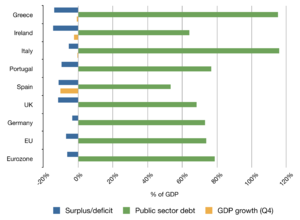
This week's chart focuses on the European debt crisis again because it remains unresolved:
The countries in crisis (PIIGS) need to refinance €1.5trillion in debt over the next three years. That is a near impossible task given the projected levels of economic activity and the existing (aging) tax base in these countries. The following is a chart showing Europe's falling GDP and leading indicators:
The 'kick the can' approach used to date by the tag team of Merkle-Sarkozy has failed to convince European bond buyers. If the euro union is to be saved it is becoming unavoidable that the Bundesbank allow the European Central Bank to essentially print more euros, so weak member nations can pay their debts. This is the route taken by the US Federal Reserve to avoid a crisis meltdown of the financial markets in 2008. The other alternative is to allow (perhaps the verb should be "force") Greece and other financially weak countries to leave the union to face national bankruptcy on their own with disastrous 'knock-on' effects for over leveraged European banks:
A common currency trading zone led by Germany could be reistablished with countries willing to enforce fiscal stability on themselves. For Germans who still remember the thousands of Weimar marks it once took to buy a loaf of bread or lump of coal, it is a bitter choice either way.
Friday, November 25, 2011
Weekend Edition: Just Say No to Peace
![]() |
| credit: Johnson's Russia List |
Medvedev told Russians last Wednesday that negotiations with the United States over a missile defense system located in Europe were over. He said Russia would withdraw from the new START treaty if the impasse over missile defense continues to deteriorate, and promised to install mobile Iskander tactical nuclear missiles [image] in the European enclave of Kaliningrad as part of his military's countermeasures to a missile system which his government believes could be used against Russia nuclear deterrent. President Medvedv implied that conservative legislators in Congress were responsible for the inability to reach agreement, saying "legislators in some countries openly state the whole system is against Russia". Russia views the US led missile defense program as a "fait accompli" that could in "6 to 8 years weaken our nuclear deterrent." War mongers in Congress categorically refuse to allow a legal pledge from the United States to Russia that it would not use a missile defense system in Europe to cloak its own offensive nuclear weapons, or engage in a cooperative system of sector defense as proposed by President Medvedev. They called the effort to provide missile data to Russia and consultations on the building process "was never realistic" since the Russians "seek to limit US missile defense by any means." The Unites States pledged not to limit its deployment plans for a European missile shield despite President Medvedev's statement. It announced a new radar site in Turkey that can detect low trajectory missile launches from Iran (Shahab-3) as well as southern Russia in September. US espionage efforts to counter the Iranian program were seriously knocked back by Iran's rolling up of US informant networks.
Toontime: Occupy This!
![]() |
| [credit: Pat Bagley, Salt Lake Tribune] Wackydoodle sez: She'll show y'all a real good time! |
Thursday, November 24, 2011
Keystone XL Off the Radar Now, But Not Down
Environmentalists are thankful for the delayed Keystone XL decision, but the battle to stop more tar sand crude from coming south is not over. Production of bitumen at the northern Alberta site is backing up due to tight pipeline capacity. Syncrude Canada, Ltd. produces 350,000 barrels a day, but has had to delay shipments due to lack of space. Kinder Morgan's 300,000bpd Trans Mountain pipeline was oversubscribed by 24% in December 2010. Consequently the search is on for alternative routes to refineries. The state of Nebraska will finance a supplemental environmental impact study of an alternate route through the state for Keystone XL, bypassing the Sandhills. Many of the objections to the original route that crosses the critical Ogallala aquifer came from politically connected Nebraskan ranchers who are not categorically opposed to the pipeline. The first Keystone pipeline already crosses the state, and it began carrying tar sand last year. In a state with a declining population, the prospect of an extra 150 million a year in property taxes paid by TransCanada Corp. is hard for impoverished local governments to resist. The US State Department has said that the supplemental study is necessary before it can make the "national interest" determination, perhaps signaling that an alternate route which avoids the acquirer may be sufficient for a second term administration to make a positive finding.
Despite the setback to the XL, Canadian firms are actively looking for ways to flow tar sand oil south in greater quantities. Recently Canadians bought up thousands of miles of existing pipelines in the Midwest to accommodate the large amount of product coming from the strip mining operation in Alberta. It is considered an interim workaround solution, with not enough capacity to carry future production. An alternative solution to the US midwest route is to carry the bitumen westward over the Rockies to Canada's Pacific coast where it could be transshipped to California refineries which have spare capacity and have been recently upgraded to handle heavier (dirtier) crude oil. Sources of crude from Alaska and within the state are dwindling. The western route involves two pipelines, expanding the existing Kinder Morgan Trans Mountain and the proposed Enbridge Northern Gateway. Either way, the ultimate consumer is the Chinese dragon that has an increasing appetite for oil. Because of the intense energy required to process bitumen into fuel, it has a carbon footprint of 10-20% larger than light oil, so bitumen as a fuel is not congruent with California's plan for a green energy future.
There are objections to the Pacific route too. The possibility of increased oil tanker traffic at Vancouver, British Columbia already has local environmentalists alarmed and their cell phones sounding off. The Wilderness Committee based in Vancouver is providing oil tanker alerts to cell phone users. The service alerts when a tanker is preparing to fill up at Kinder Morgan's Westbridge terminal to the Trans Mountain pipeline system. According to the Wilderness Committee the alerts are intended to make residents aware of the risks of an oil spill and climate change due to expansion of oil exports. Tanker traffic could increase from two a week to nearly one tanker a day in 2016 if Kinder Morgan is allowed to expand its pipeline. Kinder Morgan has plans to dredge the Second Narrows channel to allow access by super tankers that can carry one million barrels of crude oil, four times what was spilled by the drunken captain of the Exxon Valdez. Canadian environmentalists say they are determined to prevent the B.C. coast from becoming another Gulf Coast.
The proposed Northern Gateway pipeline is even more problematic for environmentalists. Enbridge's plan is to send as many as 220 super tankers a year through the narrow, serpentine passages of the Great Bear Rainforest, North America's largest temperate rainforest. The Northern Gateway would stretch 700 miles from northern Alberta over the Rockies to the port of Kitimat. From there there the dirty crude would be shipped south to California. NRDC says the plan is "one of the most reckless and potentially catastrophic proposals" ever considered. Clear cutting would be required to create a right of way and it would cross thousands of salmon steams and the headwaters of major rivers like the Fraser. The sea passages involved are even more difficult to navigate than Prince William Sound. The British Columbia coast is no stranger to environmental protests. It was the locus for protracted disputes over industrial logging. Conservationists succeeded in protecting more than five million acres of rainforest with a landmark agreement between the British Columbia government and First Nations in 2006. The white variant brown bear or "spirit bear" [photo] was adopted as the campaign's symbol. Already more than 70 First Nations along the proposed pipeline and tanker route have indicated their opposition to the plan, and so another fight begins.
Subscribe to:
Posts (Atom)