 |
| credit: Koala Beach Estate |
Monday, April 30, 2012
New Protections for Australia's Teddy
Chart of the Week: Austerity or Bust
The commoners of Europe are putting the message out to their leaders that austerity is not working to revive their economies. The latest installment in the saga is the collapse of the Dutch coalition government. The right wing nationalist party exited government with its leader declaring no more "diktats from Brussels". Europe is in recession and austerity government budgets are intensifying the effects of recession:
 Unemployment is rising as government spending decreases in an attempt to bring down national deficits.
 However, most Keynesian economists hold that less spending is exactly the opposite of the fiscal policy that should be in place during enevitable down cycles.
 As Keynesian Paul Krugman penned in his NYT column, "the confidence fairy has died". Many experts are admitting the myth of austerity bringing back investor confidence and thus an upswing in economic activity, is just that--a myth*. 85% debt to GDP is hardly Greece level indebtedness. Europe could still go some spending to stimulate the Continent's economies and ease the recession. France's economy is slowing down with unemployment at the highest level in twelve years and 13.5% of the population in poverty. French president Nicholas Sarkozy, unmistakably identified with the austerity policies of Brussels and Frankfurt, lost the first round in the election against his socialist rival as a result, and will probably loose the run-off. Irish unemployment is at 14.7% after three years of fiscal austerity. The founding party of the free state, Fianna Fail, has lost every one of it's seats in parliament. But as long as the plutocrats who fear only inflation are in control of the ECB stimulus spending is not going to happen. ECB head Mario Draghi told the Wall Street Journal recently, "there was no alternative to fiscal consolidation". Fiscal austerity is self-defeating, and now even the boulevardiers know it.
*On this side of the pond, Arthur Laffler, he of the infamous curve of voodoo economics, convinced "Darth' Cheney then serving in the House of Representatives, that cutting taxes on the rich would generate more tax revenue. We all know now that the only thing the delusion generated was a ballooning federal deficit. In 1984 after Reagan's tax cut and again in 2006 after the Bush cut, the Treasury came to the logical conclusion that tax cuts cause a loss of revenue and have no beneficial effect on the national economy. The only question that remains in US Person's mind is did the supply-siders really believe their nonsense would work, or was it simply a cynical cover to reduce taxes on their wealthy sponsors, regardless of the national good?


*On this side of the pond, Arthur Laffler, he of the infamous curve of voodoo economics, convinced "Darth' Cheney then serving in the House of Representatives, that cutting taxes on the rich would generate more tax revenue. We all know now that the only thing the delusion generated was a ballooning federal deficit. In 1984 after Reagan's tax cut and again in 2006 after the Bush cut, the Treasury came to the logical conclusion that tax cuts cause a loss of revenue and have no beneficial effect on the national economy. The only question that remains in US Person's mind is did the supply-siders really believe their nonsense would work, or was it simply a cynical cover to reduce taxes on their wealthy sponsors, regardless of the national good?
Friday, April 27, 2012
'Toontime: Next Stop, Margaritaville

[credit: Paul Ramirez, Business Investor Daily]

[credit: Clay Jones, Free-Lance Star]
Thursday, April 26, 2012
Polar Bears Show Less PCBs

Tuesday, April 24, 2012
Weekend Edition: BP Concealed Caspian Blowout
 |
| NYT: heat buckles Deepwater Horizon |
{21.04.12} US Person is advocating a criminal prosecution of British Petroleum for the Deepwater Horizon disaster {The Gulf of Mexico is Sick, 03.04.12} because the record so far establishes that the company acted recklessly in dealing with the problematic Macondo well in deep water. His conclusion is backed up by incidents from the company's past operations in Alaska and Texas {Deepwater Horizon}. But the latest evidence of BP's corporate culture of 'damn the regulations and save money' comes from Baku in the Caspian Sea. Admittedly, operating in the Caspian Sea is not subject to the same regulatory environment as the Gulf of Mexico, but what is relevant is that BP concealed from US regulators, and the International Drilling Contractors Association that "quick dry" cement on a runaway Caspian well failed in 2008 only two years before the Deepwater Horizon disaster. BP has attempted to blame well services company Haliburton for using the cement on the Macondo blowout. BP told a federal judge that Haliburton concealed a computer model showing quick-dry cement could fail disastrously, but if BP had informed Haliburton of its experience in the Caspian Sea, the Macondo well might have been brought under control much sooner. Nitrogen injected into cement to speed drying can cause channels which allow methane to escape and blow out the well bore cap. This information comes from an exclusive report by Greg Palast writing at EcoWatch.org. Palast's story is based on an interview with an eyewitness rig worker confirmed by other industry insiders. BP was able to cover-up the 2008 incident with the help of Azerbaijan authorities, other oil companies, and according to Palast, the second Bush Administration.
BP acknowledged there was an incident in 2008 but mischaracterized the event as "a gas leak in the area of the platform" in its SEC filing. Witnesses said the methane blew out through the drilling stack, engulfing the platform. The Caspian well suffered cracking of its casing allowing methane to escape into the sea. The ensuing evacuation was chaotic according to platform workers. This incident is very similar to what occurred on the Deepwater Horizon platform except there the gas ignited, killing 11 workers and releasing billions of barrels of crude oil that is still poisoning the Gulf two years later. BP's Vice-President for Operations told Congress gas releases were rare five months before the explosion aboard the Deepwater Horizon without mentioning the Caspian Sea incident. Workers who know about such events are reluctant to report them outside the industry for fear of being blackballed from high paying offshore jobs. But a Wikileaks cable reveals that company VP Bill Schrader told the US ambassador the emergency evacuation of the Central Azeri platform on September 17, 2008 was the biggest in BP's history. In the cable, the ambassador opined that BP was "quite fortunate to have been able to evacuate everyone [211 workers] safely and to prevent any gas ignition." Regardless of fortune, BP was focused on the $50 million per day it was losing while the platform was shut down. Cooperation of Azeri officials was secured with $75 million in bribes paid by company executives. BP's luck with fast and loose operations ran out aboard the Deepwater Horizon platform in the Gulf of Mexico on April 20, 2010.

 |
| red snapper lesion |
Former Icelandic PM Goes on Trial
Update: Former Prime Minister Geir Haarde was convicted of one criminal count against him by the Landsdomur on Monday. He was convicted of failing to take steps to assess the risks to the state after the private banking system collapsed. Haarde dismissed the conviction as a formality and said he might appeal to the European Court of Human Rights. A special parliamentary committee release a report in September alleging Haarde and former central bank head David Oddsson knew that private banks were accumulating overseas debt but that they were grossly negligent in failing to mitigate the effects.
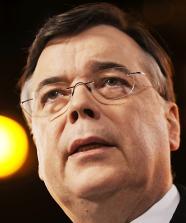
{06.03.12} Geir Haarde [photo] is facing charges of negligence related to the 2008 Panic in court. Iceland's three major banks collapsed in 2008 due to excessive foreign lending while Haarde was leader of the ruling Independence Party. A legal motion to dismiss all charges against him was denied last year and Parliament declined last week to grant a request from the current Independence Party leader to dismiss the charges. Haarde plead not guilty in June, and has steadfastly maintained the charges are politically motivated. Parliament referred the charges to a special court for trying cabinet ministers after a special investigation committee released a truth report in which it said that seven officials acted with "gross negligence" in their management of the country's financial system prior to the bank failures. The report concludes that Haarde and the central bank head knew the banks were accumulating foreign debt at a rapid pace but were failing to hedge the risks. In April 2008 there were at least five meetings between Haarde and the central bank directors. Before the crisis Iceland's banks had foreign assets worth more than nine times the nation's GDP with equivalent debts. This situation was coupled to a monetary policy that kept interest rates high causing an inflow of foreign currency that overwhelmed the central bank's foreign currency reserves. When the liquidity crisis hit in 2007, Iceland banks were left holding a bag of worthless loans and collateralized securities. Some of the loans were made to former bank heads. In 2008 Kaupthing, Landsbanki and Glitnir were taken over by the government. They were holding debt equal to more than 900% of Iceland's GDP. They were truly too big to rescue. Iceland was forced to accept loans from the IMF to recover from the crisis. Massive public protests against the imposed austerity measures {Iceland} forced Haarde and his rightwing coalition government from office. Iceland now has its first leftwing government.
 |
| credit: AFP |
Weird Weather Linked to Arctic Meltdown
Did readers in the northeast enjoy the late blast of winter after basking in 80 degree April sunshine? US Person endured two months of almost continuous cold and rain in March and April here in the northwest. So what's up with the weird weather? Besides the usual suspects like La Niña, and El Niño, scientists are becoming aware of the impacts of "Arctic Amplification" the alterations in the jet stream caused by a rapidly warming Arctic region. The Arctic has lost 40% of its ice cover in summer in just three decades. The jet stream is a river of moving air that flows between 30 north latitude and 60 degrees, separating cold air from warm. As the arctic melts the temperature difference lessens which changes the jet stream in two ways.
The west to east speed of the jet streams slows. Over the North Atlantic wind speeds have dropped by about 14% since 1980. That allows weather systems to persist leading to phenomena of heavier snowfalls and longer periods of cold or hot weather. Deep troughs in the jet stream persisted over the East coast during the winters of 2009-10 and 2010-11, bringing record snow fall amounts and very cold weather. This winter has been unusually warm in the northeast with much less snow fall because the region was under a ridge or northward bulge of the jet stream. At the same time in Alaska a deep trough dumped record amounts of snow. Secondly, the perturbations in the stream or 'waviness' increases allowing the intrusion of tropic air farther north, "ridges", and arctic air farther south, "troughs". These waves of air often lead to record breaking temperatures. Predicting long range weather patterns is difficult work, but a safe conclusion is that as the Earth continues to warm up because of man's activities, weather will get more "weird".
Subscribe to:
Posts (Atom)