 Wolverines (Gulo gulo), the largest member of the weasel (Mustelidae) family, have suffered at the hands of man. Nearly trapped and hunted out of existence in the lower forty-eight states, they were proposed for listing under the Endangered Species Act in 2013 but the Fish & Wildlife Service reversed course in 2014, over uncertainties of how climate change was impacting the species. Resistance to the listing was also centered on concerns that designating protected habitat would "rope off" large sections of high alpine landscape. Wolverines need deep snow pack at high elevations that last until late spring to reproduce. Females dig elaborate dens in the snow to raise their offspring. The kits--usually two--live with their mother until two years old. [photo] There are fewer than 300 wolverines in the contiguous states, and they could loose up to a third of their snowy habitat by the turn of this century. There is good news for the wolverine, however. Scientists have discovered wolverines, male and female, living in Wyoming's Wind River Range during the first wide-ranging wolverine survey conducted this spring by federal, state and tribal agents. A breeding female was also located in Washington's South Cascade mountains.
Thursday, May 31, 2018
More Wolverines Found
Wolverines (Gulo gulo), the largest member of the weasel (Mustelidae) family, have suffered at the hands of man. Nearly trapped and hunted out of existence in the lower forty-eight states, they were proposed for listing under the Endangered Species Act in 2013 but the Fish & Wildlife Service reversed course in 2014, over uncertainties of how climate change was impacting the species. Resistance to the listing was also centered on concerns that designating protected habitat would "rope off" large sections of high alpine landscape. Wolverines need deep snow pack at high elevations that last until late spring to reproduce. Females dig elaborate dens in the snow to raise their offspring. The kits--usually two--live with their mother until two years old. [photo] There are fewer than 300 wolverines in the contiguous states, and they could loose up to a third of their snowy habitat by the turn of this century. There is good news for the wolverine, however. Scientists have discovered wolverines, male and female, living in Wyoming's Wind River Range during the first wide-ranging wolverine survey conducted this spring by federal, state and tribal agents. A breeding female was also located in Washington's South Cascade mountains.
Monday, May 28, 2018
Google's Feral Cats Threaten Burrowing Owls
It seems the tech folks at Google's campus in Southern California are cat lovers just like US Person. But a good deed never goes unpunished, and that apparently is the case with an employee group's policy of feeding feral cats inhabiting the Mountain View campus, known as "Googleplex". The group traps feral cats and kittens and sends the friendly ones to adopting guardians. The unfriendly ones are neutered and released. The ferals are fed from feeding stations scattered about, night and day. So far, so good.
However, the Googleplex is located next to Shoreline Nature Reserve, which is home to perhaps fifty of the few remaining burrowing owls, Athene cunicularia, in the valley. [photo credit: Audubon Society] They make their underground nests in the deep grass of the 750 acre reserve. That inaccessibly does not stop one of the supreme hunters of the natural world, Felis cattus. Owl remains-- a wing here, a beak there, and a few remaining feathers--testify to their ability to prey on the threatened owls. Even cats that are fed regularly, hunt, as most cat guardians will tell you. The beloved charges will bring into the house their hunting trophies to show their human companions, or pehaps even feed their horribly inept caretakers. Even if a cat does not catch or kill a bird, their presence is enough to interfere with a bird's normal behavior, such as breeding.
 Last year 318 feral cats were sighted in Mountain Home, according to city records. 2017 was the first time in twenty years of record keeping that no fledgling owls were observed in the park. In 2010, ten were counted. According to an environmental group attempting to expand the San Francisco Bay Natural Wildlife Refuge, Google has refused to remove the feeding stations or interfere in the activities of its employee group, which it says numbers around ten people.
Some companies, such as Facebook whose property abuts a marsh, stopped allowing feral cat feeding several years ago. Even if companies adopt a policy of not feeding feral cats, city people are willing to take up the task. A records request shows that city employees have discussed the impacts of Google's feral cat feeding on local protected wildlife. A feral cat chipped by the employee group was trapped in the park; turned over to Google by the city's animal control authority; trapped again in the park; and released again to Google. Last August this feral cat was found dead in the park. True to their genetic heritage, cats do want they want.
However, the Googleplex is located next to Shoreline Nature Reserve, which is home to perhaps fifty of the few remaining burrowing owls, Athene cunicularia, in the valley. [photo credit: Audubon Society] They make their underground nests in the deep grass of the 750 acre reserve. That inaccessibly does not stop one of the supreme hunters of the natural world, Felis cattus. Owl remains-- a wing here, a beak there, and a few remaining feathers--testify to their ability to prey on the threatened owls. Even cats that are fed regularly, hunt, as most cat guardians will tell you. The beloved charges will bring into the house their hunting trophies to show their human companions, or pehaps even feed their horribly inept caretakers. Even if a cat does not catch or kill a bird, their presence is enough to interfere with a bird's normal behavior, such as breeding.

Some companies, such as Facebook whose property abuts a marsh, stopped allowing feral cat feeding several years ago. Even if companies adopt a policy of not feeding feral cats, city people are willing to take up the task. A records request shows that city employees have discussed the impacts of Google's feral cat feeding on local protected wildlife. A feral cat chipped by the employee group was trapped in the park; turned over to Google by the city's animal control authority; trapped again in the park; and released again to Google. Last August this feral cat was found dead in the park. True to their genetic heritage, cats do want they want.
Sunday, May 27, 2018
"Toontime: Black Kettle
 |
| credit: Dave Granlund |
 | |
| credit: Adam Zyglis, Buffalo News |
Friday, May 25, 2018
COTW: The Angry Nation

Hair Further canceled the impending summit between North Korea and the United States. He called the other side "angry and hostile" in his letter to the North Korean dictator. North Korea applied some heated rhetoric to John Bolton and Vice President Pence for their invocation of the "Libya model" as a way to deal with the nuclear-armed regime. A top female aide to Chairman Kim called Pence "a political dummy". It was Pence who infamously snubbed Kim's sister at at an Olympic games venue this winter. Look at this chart and decide for yourselves, which nations are angry and hostile. Once again a highly neurotic and oversensitive leader is endangering the safety of his fellow citizens by playing a game of nuclear brinkmanship, encouraged by known warmongers on his executive staff. As one commentator succinctly summed up Trump's diplomatic faceplant: "The man who thinks he’s the greatest negotiator in the world has absolutely no idea how to negotiate." Trump himself practices the ghoulish art of the insult, so he should know what is "unacceptable" rhetoric.
This Memorial Day weekend many Americans will be remembering service personnel at their gravesides. If thermonuclear war breaks out, there probably will not be remains of thousands of victims to memorialize. Undoubtedly the United States would unleash massive retaliation on the Korean peninsula if an attack were launched, reducing North Korea to ashes, but not before one or perhaps several west coast cities and Seoul evaporate in a nuclear or thermonuclear explosion.
The risk of a nuclear mistake is perhaps greater now than during the Cold War; the news of fourteen USAF personnel ingesting LSD while on duty at nuclear missile installations in Wyoming is far from reassuring. The technology may be new, but it still depends on fallible human command. By placing ever-increasing reliance on a massive nuclear arsenal as a means to bully other nations into complying with United States hegemony is only making the world more precarious. Scuttling a break-through opportunity to begin Korean disarmament and end the Korea War will be counted as more bad Trump behavior. The summit cancellation will join the Paris Climate Accord pullout, Iran nuclear deal pullout, and moving the U.S. embassy to Jerusalem, as examples of his own irrationality and hostility.
Thursday, May 24, 2018
Cheating the Planet's Health with CFCs
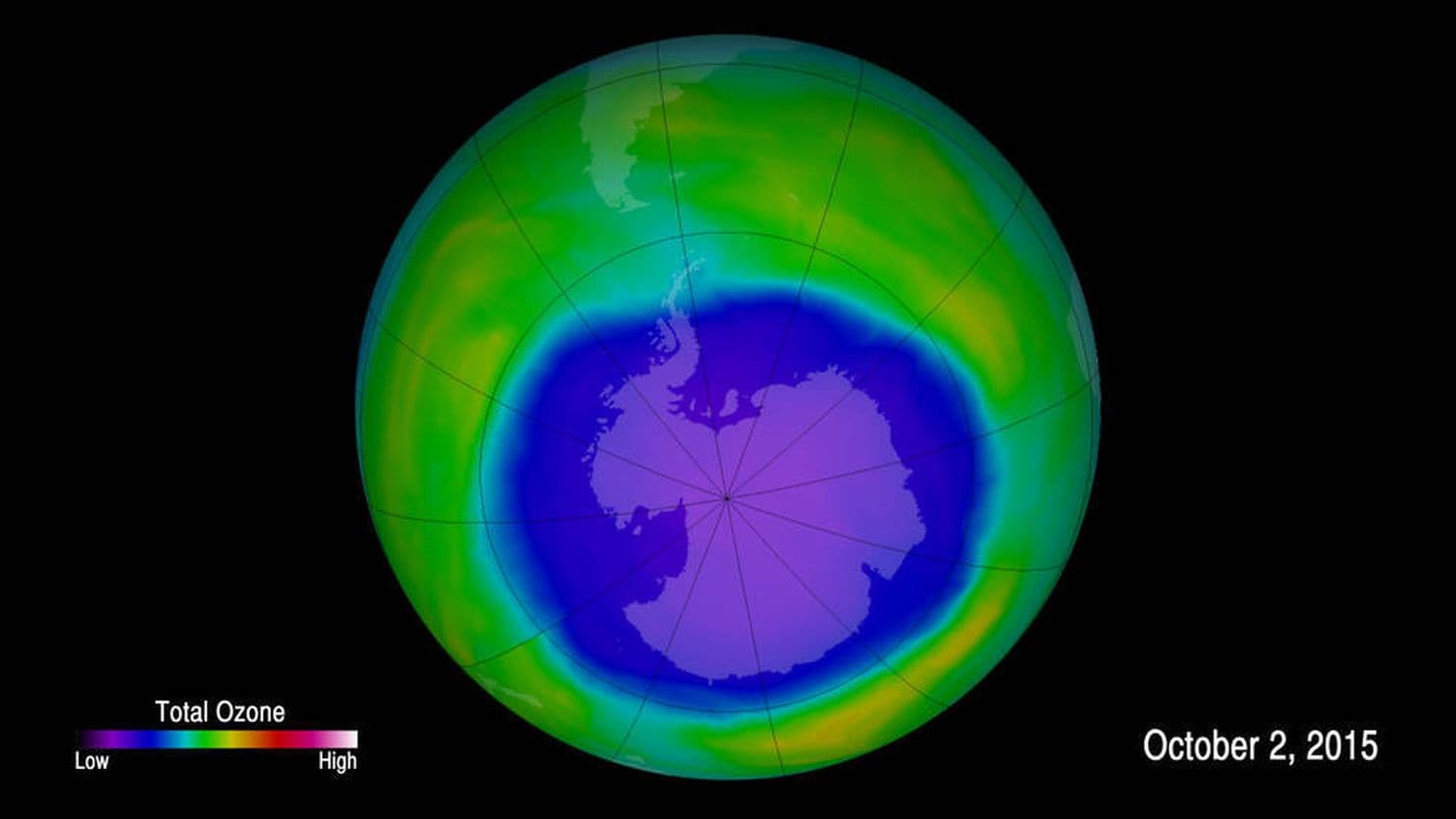
Alternatives exist for chlorofluorocarbons, so it is not easy to understand where a market for the chemical could exist. CFC-11 was used for foam and can last up to 50 years in the atmosphere. It is broken down only in the upper stratosphere, where the constituent chlorine atoms engage in a series of ozone destroying reactions. If the emissions continue unabated, ozone layer recovery could be threatened again. [image credit: NASA/Goddard Space Flight Center] The releases have slowed the rate of decrease in ozone destroying chemicals by 22%
Tuesday, May 22, 2018
The Real Grey Ghost

The tragedy does not end there, unfortunately. Two weeks after the Selkirk's demise was made public, researchers announced that another herd, known as the South Percells, just north of British Columbia is down to four members--three females and one male. Caribou numbers have been declining for decades as the result of human disturbance and fragmented habitat. Nevertheless it is a shock to realize that these imposing inhabitants of the boreal forest will be gone forever. Conservation plans have not halted the declines in population. Some fewer than 1200 caribou remain in Canada's mountainous forests. Canada's environment minister announced this month that the federal government will step in to help preserve the remaining caribou if the provincial government does not act decisively to protect core habitat soon. The message is clear: remaining herds cannot afford to wait for man's help.
A similar extinction befell the woodland caribou herd in Alberta’s Banff National Park. The herd dwindled to a point where a single avalanche wiped out its last remaining members in 2009--gone forever. It is relevant to note that as much as 70 percent of Alberta’s oil sands reserves are found within caribou habitats. Caribou need dense forest to survive the harsh environment in which they live. Watch this video about the real vanishing ghost.
Saturday, May 19, 2018
'Toontime: Moles in Your Campaign
 | |
| credit: Steve Sack, Star Tribune BC Idonwanna sez: Keep scores secret or you red face! |
If the Donald is anything, he is a master of media manipulation. His latest gambit in the Russian Connection affair is attempting divert attention away from Robert Mueller's legal activities towards an intensifying dispute between the US Justice Department and his allies on the House Intelligence Committee. They have uncovered the existence of a spy, to put it bluntly, that reported on the activities of the Trump Campaign. Now they want to know the spy's identity, but Justice is stoutly refusing to provide the identity which may endanger individuals involved in the undercover operation. The standoff between Chairman Nunes, and Assistant Attorney General Rod Rosenstein, overseeing the Mueller investigation, could escalate into a refusal to obey a presidential order to hand over the information, and Rosenstein's removal from office. That event may force congressional Repugnants to either side with their erstwhile chief executive, or the rule of law. The standoff has definitely given the hot-headed Hair Further more ammunition for his one-man twit crusade.
The Washington Post reported Friday that a university professor, and longtime FBI informant, had three meetings with members of the Trump campaign. As some point in 2016 he--his identity is known by the Post but not reported--began reporting information about Russian meddling in the election. Partisans are now claiming that the informant was illegally embedded by the Obama Administration. Whether this claim has any substance is largely besides the point. The story makes excellent counter-propaganda and provides a plausible basis for direct action against Justice personnel running the Russian Connection investigation, which has now entered its second year. The sooner Mr. Yuge derails the investigation, the better for him, as Mueller painstakingly follows the leads leading to the President's direct involvement with Russian operatives.
Subscribe to:
Posts (Atom)